Claude System Prompts Audit Workflow 2026 — Reading 3,000 Words of Steering Instructions
Quick Verdict
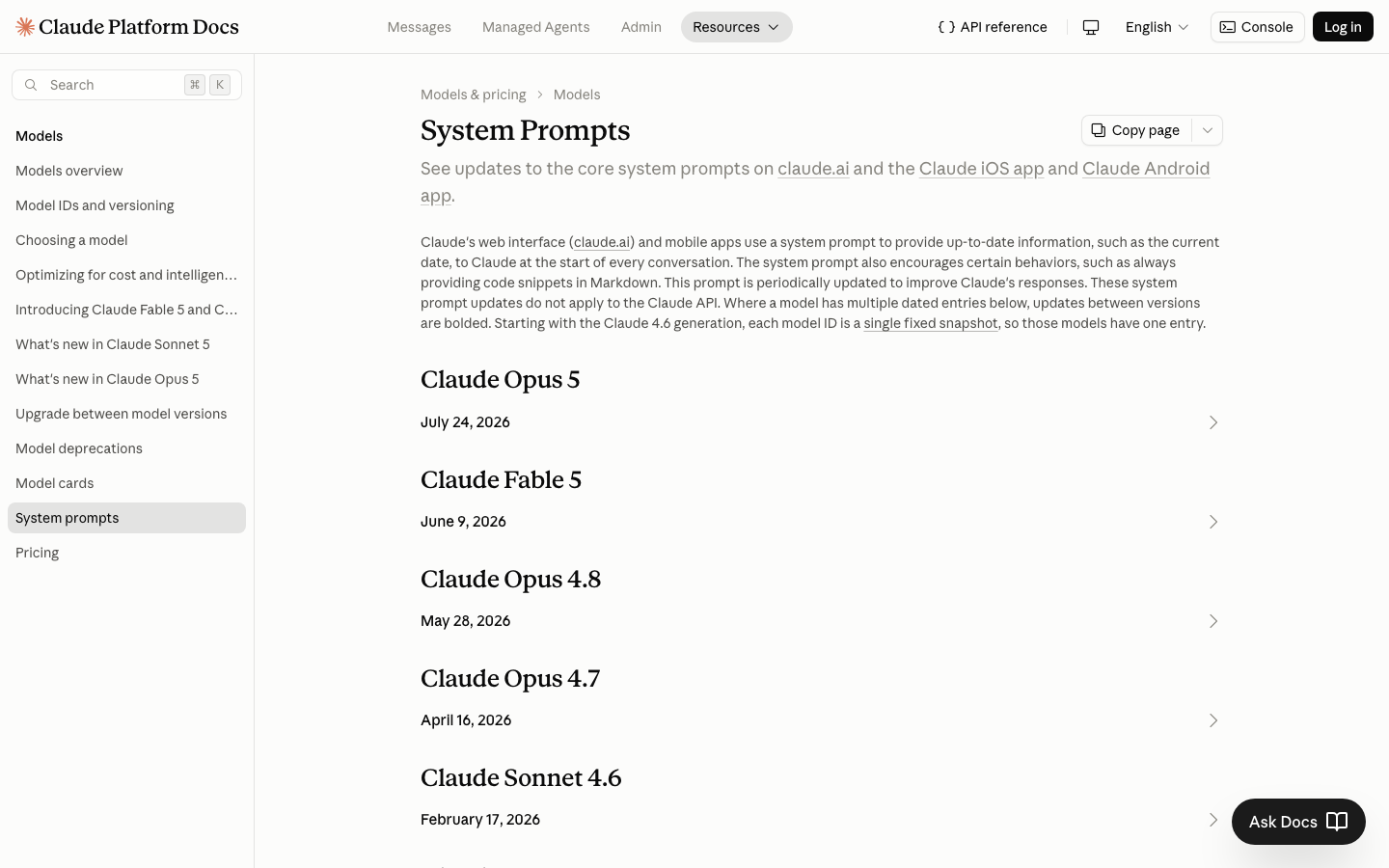
On August 16, 2026, Anthropic quietly updated its System Prompts release notes page — a full transcript of the system prompts that steer claude.ai, the Claude iOS app, and the Android app, going all the way back to 2024. The document is a rare, literal look inside how a frontier lab steers its consumer product, and it confirms what HN commenters (476 points, 209 comments, the #1 AI story of the day) have suspected for months: these prompts have accreted from ~124 words (Haiku 3) to 3,231 words (Opus 5) — building-code style, written in response to incidents and loopholes rather than designed up front.
Three findings matter most for anyone who builds on top of Claude:
- The consumer prompts do NOT apply to the API. Simon Willison, who maintains an extract-system-prompts diff repository, confirmed in the thread: “These system prompts don’t affect the API, they are for the Claude consumer chat products.” Claude Code has its own unpublished prompts — which API users pay for at cached-token rates.
- The prompts now contain a safeguards-routing block. Opus 5’s prompt tells the model that Fable 5 requests may have been redirected to it, and to respond as Opus while acknowledging the user’s confusion. That’s the observable fingerprint of Anthropic’s conservative-tuned safeguards firing on fewer than 5% of sessions.
- They are structured like a config file, not prose. Tagged blocks (
<claude_behavior>,<product_information>,<fable_safeguards_routing>,<default_stance>,<refusal_handling>,<critical_child_safety_instructions>) make the prompt machine-editable — which is exactly why a git-diff audit workflow works so well on them.
Community pulse: the thread split into two productive debates — (a) why not bake the prompt into the weights? (answer: flexibility, retraining cost, and the fact that consumer prompts vary by product surface; the “soul document” concept covers the always-apply layer), and (b) are 3,000 words of instructions contradictory and self-defeating? (one commenter pointed out Anthropic’s own context-engineering guidance warns against contradiction-laden prompts — then asked Claude to find the contradictions in its own prompt).
The Data: Prompt Growth by Generation
I extracted every prompt from the release-notes page and counted words per model generation. The growth curve is the story:
| Model / Generation | ~Word Count | Notes |
|---|---|---|
| Claude Haiku 3 (2024) | ~124 | Minimal: identity, date, knowledge cutoff |
| Claude Opus 3 | ~360 | Identity + date + model facts |
| Claude Sonnet 3.5 | ~10,900 | First massive expansion (tool/product surface) |
| Claude Opus 4 | ~6,842 | Peak of the “kitchen sink” era |
| Claude Haiku 4.5 / Sonnet 4.5 | ~6,443 | Shared prompt family |
| Claude Opus 4.6 | ~2,829 | First big trim |
| Claude Sonnet 4.6 | ~2,892 | |
| Claude Opus 4.7 | ~3,683 | |
| Claude Opus 4.8 | ~3,354 | |
| Claude Opus 5 (current) | ~3,231 | Tagged-block structure, safeguards routing |
| Claude Fable 5 (current) | ~3,286 | Adds dual-use safety language |
Two eras are visible: the expansion era (Haiku 3 → Sonnet 3.5/Opus 4, where every product feature and edge case got a paragraph) and the restructuring era (4.6 onward, where Anthropic cut word count roughly in half and moved to a tagged, block-structured format). The modern prompts are denser per word — structured instructions instead of prose.
What’s Actually Inside the Opus 5 Prompt
The Opus 5 prompt (dated July 24, 2026) is organized into explicit XML-style blocks. Reading them in order reveals the product’s actual priorities:
<claude_behavior> + <product_information> — identity, product surface, and model facts. Notable content: the prompt tells Opus 5 about Mythos tier (Claude Mythos Preview, Project Glasswing, restricted to trusted organizations), and the June 12–30, 2026 export-control suspension of Fable 5/Mythos 5 — “These events are after Claude’s training-data cutoff, so Claude knows about them only from this notice.”
<fable_safeguards_routing> — the block HN found most striking. Verbatim mechanism: “It’s possible that the user may have selected a different Anthropic model, ‘Claude Fable 5’, but their query was redirected to Opus 5 instead due to a safeguards routing mechanism.” Anthropic’s own quote inside the prompt says safeguards are tuned conservatively, trigger in fewer than 5% of sessions, and will sometimes catch harmless requests. Translation: the most capable model is gated by a router, and the second-tier model is told to explain the redirect as itself rather than impersonate the model the user picked.
<default_stance> — “Claude defaults to helping. Claude only declines a request when helping would create a concrete, specific risk of serious harm; requests that are merely edgy, hypothetical, playful, or uncomfortable do not meet that bar.”
<refusal_handling> + <critical_child_safety_instructions> — a dedicated, bolded child-safety block with explicit rules against producing content that could sexualize, groom, or harm minors. This block is new relative to the early prompts, which per one commenter had “no child safety guardrails in the prompt at all.”
Style instructions — including the line HN roasted: “Claude keeps responses focused, brief, and concise to avoid overwhelming the person” — followed immediately in the same thread by users quoting Claude’s actual behavior (“Claude and I must have a different idea of what brief and concise mean”).
The Audit Workflow: Tracking a Moving Prompt with Git
The release-notes page is a point-in-time transcript, but Anthropic updates it on every prompt refresh. To audit changes over time, the workflow HN commenters converged on is:
Step 1 — Snapshot. Fetch the current transcript. The docs expose a markdown endpoint (platform.claude.com/docs/en/release-notes/system-prompts.md) that is much easier to diff than the rendered page.
Step 2 — Version it. Commit each snapshot to a git repository. Simon Willison maintains simonw/research with an extract-system-prompts directory that rebuilds these as commit history — “so you can more easily see what has changed.” For example, the diff between Opus 4.8 and Opus 5 is directly visible as a commit.
Step 3 — Diff with intent. When a new model or prompt version ships, diff against the previous snapshot and classify changes into: (a) product-surface additions (new tools, new features — low behavioral risk), (b) guardrail changes (safety blocks, refusal handling — high behavioral risk), (c) stance/steering changes (defaults, style instructions — medium risk, affects user experience).
Step 4 — Correlate with behavior. If you run evaluations against Claude (or a proxy of it), tag your eval runs with the prompt-version commit hash. When a quality regression appears, the first thing to check is whether the system prompt changed — this workflow turns “the model got worse” into “the steering document changed on date X, here’s the diff.”
Why the “Why Not Bake It Into the Weights?” Question Matters
The most substantive HN thread asked why Anthropic charges token weight for a 3,000-word prompt it could theoretically bake into the model. The answers are worth internalizing for anyone who designs LLM products:
- Flexibility. A baked-in prompt requires retraining to change. A context prompt is a config change. Anthropic updates these prompts frequently (multiple dated entries per model on the release-notes page).
- Product-surface variance. The same underlying model serves chat, mobile, and API differently. One commenter’s example: “When you call via the API and want it to roleplay as a pirate or fix broken YAML in the coding harness — it doesn’t need to know about the sports scores lookup tool.” A single baked prompt can’t serve all surfaces.
- It’s cacheable. Simon Willison: “They’re also prefix cached, so the cost to Anthropic and performance hit is greatly reduced.” The prompt isn’t re-invoiced at full rate on every turn.
The counterpoint — contradiction risk — is real: comboy noted “instructions containing contradictions lead to diminished quality,” and Anthropic’s own Claude 5 context-engineering guidance warns the same thing. The 3,000-word prompt is a liability surface as much as a steering mechanism.
When This Workflow Pays Off
Use the audit workflow when: you build products on Claude (or any lab’s chat product), you run quality evals that need a changelog for behavioral drift, or you’re benchmarking model behavior and need to control for prompt-version as a variable.
Skip it when: you only use Claude via the API (the consumer prompts don’t apply — your system prompt is your own), or you need real-time detection of changes (Anthropic publishes updates on its own schedule; the git workflow is retrospective by design).
FAQ
Q: Do the published system prompts affect my API calls? A: No. The release-notes page explicitly states these prompts apply to claude.ai and the mobile apps. API users get their own system prompt (whatever you send), and Claude Code runs on its own unpublished prompt — which you do pay for at cached-token rates. Simon Willison confirmed this in the HN thread.
Q: Why did the prompt grow from ~124 words to ~3,200? A: The early prompts only carried identity, date, and knowledge-cutoff facts. Over time Anthropic added product features, guardrails (child safety), model-tier routing (Mythos/Fable/Opus), and stance instructions in response to incidents and user behavior — the same accretion pattern as legal boilerplate, as one commenter put it: “written in blood.”
Q: What is the Fable 5 safeguards routing? A: A mechanism that redirects some queries selected for Fable 5 (the most capable generally-available model) to Opus 5, triggered by conservative safety filters on dual-use topics (biology, cybersecurity, LLM R&D). The Opus 5 prompt tells the model how to handle users confused by the redirect. Anthropic says the filter triggers in fewer than 5% of sessions and is being tuned to reduce false positives.
Q: Is a 3,231-word system prompt good or bad? A: It’s a trade-off. Structured tagged blocks are cheaper to maintain and update than prose, and prefix caching makes the token cost marginal. But long prompts accumulate contradictions, and Anthropic’s own guidance warns contradictions degrade output quality. The prompt is a live liability surface — which is exactly why versioning it is a useful discipline.
Q: How do I get the current prompts for my own analysis?
A: Fetch platform.claude.com/docs/en/release-notes/system-prompts.md (the markdown endpoint diffs cleanly), or clone Simon Willison’s simonw/research repository which already maintains per-version commit history.
Verdict
Anthropic publishing the consumer system prompts is the most transparent look at frontier-model steering available today — and the transparency itself is the product signal. The prompts show a lab managing three things at once: product surface (what Claude knows about its own products), safety routing (the Fable 5 → Opus 5 redirect), and behavioral stance (default-to-help, refusal boundaries, child-safety blocks). The growth from 124 to 3,231 words, and the later restructure into tagged blocks, is a case study in how prompt engineering becomes context engineering as models get longer context windows.
For teams building on Claude, the practical takeaway is not the prompt contents — it’s the workflow: snapshot, commit, diff, correlate with eval results. Treating a vendor’s system prompt as versioned infrastructure instead of a black box turns “the model changed behavior” from a mystery into a git blame.