AI App Clone Verification Workflow — Five Checks Before Shipping AI-Generated Code
Overview
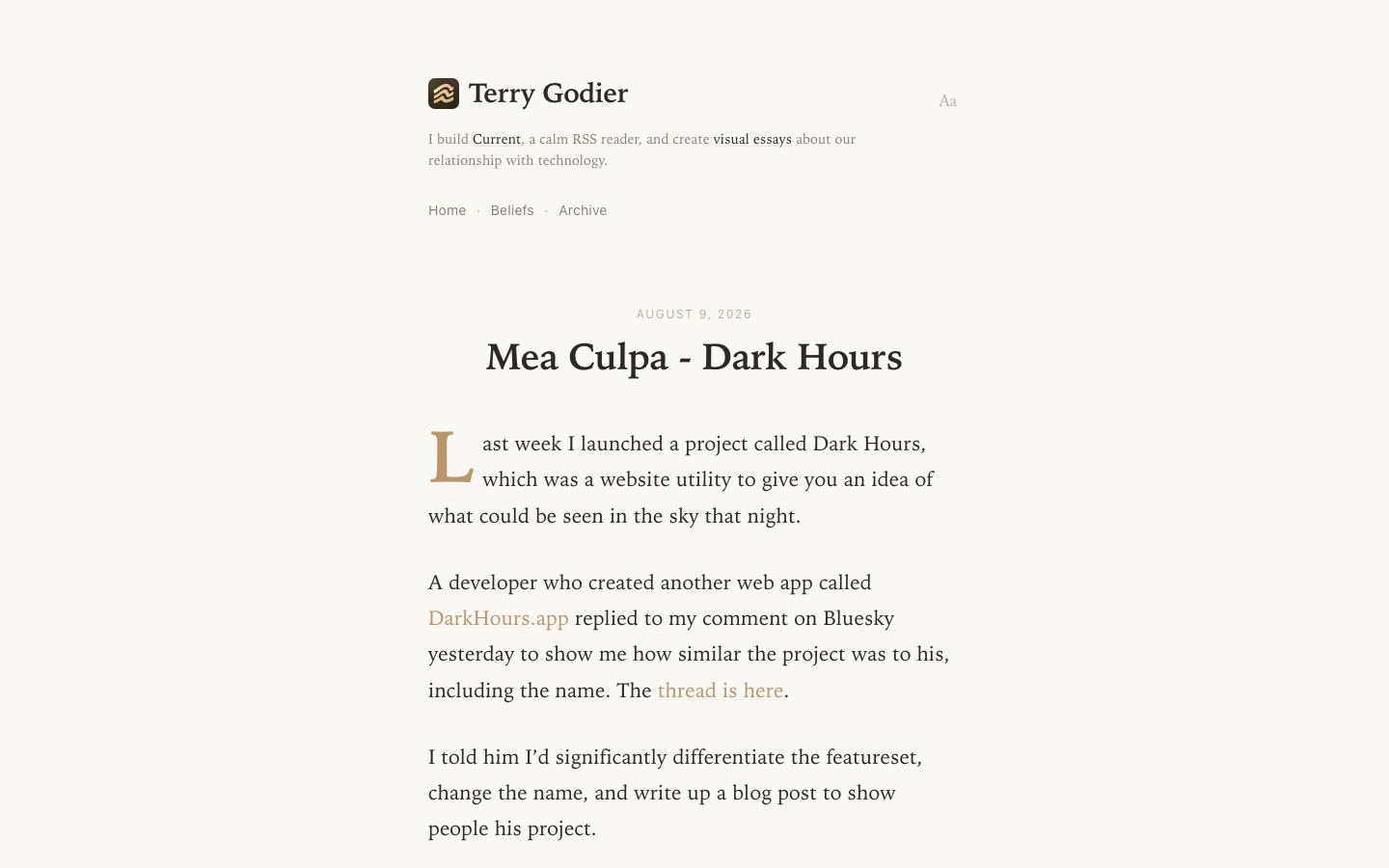
On August 9, 2026, the Dark Hours incident became one of the most-discussed AI coding stories of the week — 567 points and 257 comments on Hacker News. The short version: developer Terry Godier launched a web app called Dark Hours (built with Claude) that showed what could be seen in the night sky. Another developer, whose open-source app DarkHours.app (github.com/mbeher2200/DarkHours) did the same thing, replied on Bluesky showing how similar the two projects were — including the name and even a bug he had already fixed.
Godier’s response was a public mea culpa: he redirected his domain to the original project, killed his planned iOS app, and wrote: “I’d also like to apologize for my irresponsible use of AI to build such a thing. While I had genuinely never seen DarkHours.app before yesterday, I was careless in relying on AI to generate the project without doing the work to understand whether it closely resembled an existing project.”
The story then got worse. Daring Fireball had previously run a piece (“App Store Rejection of the Week: Dark Hours,” 346 points) framing the app as an unjust Apple rejection. Within days, Gruber published a retraction — his first in 24 years — because Godier had misrepresented the timeline: the app had originally been an astrology app rejected for Apple’s astrology policy, then pivoted to the astronomy clone. “I was misled, both overtly and through omissions,” Gruber wrote.
Whatever your read on the developer’s intent, the incident is the best public case study we have on a real AI-coded risk: your model may reproduce an existing project’s design, name, and even bugs without you knowing. This workflow turns the incident into five pre-ship checks for anyone building apps with AI assistance.
The Incident, In Numbers
- 567 points / 257 comments on HN for the mea culpa post (August 9)
- 346 points / 49 comments for the original Daring Fireball “App Store Rejection of the Week” post
- Two HN front-page posts + one Daring Fireball retraction in three days
- The clone reproduced: the same name (“Dark Hours”), the same feature set, and at least one identical bug (per the Bluesky conversation Gruber linked)
- Godier’s mitigation: domain redirect (a 302 temporary redirect, per progval — not a permanent 301, and the domain expires August 2027, so cube00 noted users who memorized the .io address may be stranded)
The community reaction split into three camps: those who praised the accountability (“Kudos to the author for taking responsibility and doing the ethical thing here” — gtowey), those who saw a pattern of deception (“The dog plagiarized my homework” — glaslong, after the retraction), and those who argued the model couldn’t plausibly clone an app bug-for-bug unprompted (“Claude has the habit of finding and fixing bugs without being asked… there’s a non-zero chance that even if it had copied the original code it would have found and fixed the accidental trap” — mft_).
Whatever camp you’re in, one thing is uncontroversial and useful: none of this had to happen, and a verification pass before launch would have caught it. Here’s the workflow.
Check 1: Name Collision Search (30 Minutes)
The most embarrassing detail — the clone shared the exact name — is also the easiest to catch. HN’s viccis described the mechanism: “A good way to accomplish this is to ask the AI to give you some good names for the project. It tends to regurgitate those, and a quick search of existing apps will flush it out.”
Do this:
- Take every name the model suggests (not just the one you pick) and search: App Store, Google Play, GitHub, Product Hunt, and a general web search.
- Search the feature description, not just the name: “night sky what’s visible tonight app” will surface DarkHours.app instantly.
- Check the exact spelling/domain of what you plan to ship, including
.app,.io, and.devvariants.
This check alone would have ended the incident before it started — the domain collision and name duplication were both discoverable in one search session.
Check 2: Model Output Similarity Audit (1–2 Hours)
The harder question is whether the code is a reproduction of an existing project. The community is genuinely split on whether Claude could clone an unseen app down to an identical bug — vikramkr argued “they’re not deterministic, they aren’t going to make the exact same bug as a project you never heard of unless it’s a specific technical shortcoming/training data gap/skill issue of the model,” while vintagedave found it “plausible” given the app’s training data, and supriyo-biswas reported that Codex “always puts an attribution link saying that part of it was adapted from that repo” when asked to implement from one.
Do this:
- Diff against likely sources. If your app has a well-known category, clone the top 3–5 open-source projects in that space and run a structural diff (component names, function names, file layout). Identical internal identifiers across projects are a red flag.
- Look for inherited bugs. Search your generated code for quirks you didn’t ask for — unusual edge-case handling, weird defaults, a specific off-by-one. The Dark Hours clone inherited a bug the original had already fixed; that’s the signature of training-data reproduction.
- Ask the model directly. Run: “Did you base any part of this implementation on an existing project? If so, which ones?” Models will often surface the attribution (as Codex does); treat a flat denial with suspicion if the code has distinctive structural fingerprints.
- Check license obligations. Even unintentional reproduction of GPL/MIT code carries obligations. If you can’t rule out copying, have a human review the license landscape before shipping.
Check 3: Story and Claim Verification (Before You Publish Anything)
The Dark Hours incident escalated because of the framing as much as the code. The original Daring Fireball piece presented the app as an astronomy app rejected for astrology — a sympathetic story. The retraction revealed the app had been an astrology app first, rejected for the astrology policy, and then became the astronomy clone. Gruber’s words: “I was misled, both overtly and through omissions.”
Do this:
- Reconstruct the actual timeline of your project before telling its story: when was the code written, what changed, what was rejected and why.
- Don’t launder the history. If your app pivoted after a rejection or a failed launch, say so. Omissions compound errors — the retraction thread (“I, too, feel entirely duped” — arjie) shows the community treats a misleading origin story as worse than the original mistake.
- Treat “the AI did it” as a claim to verify, not an explanation. quietsegfault’s comment is the operative principle: “We are personally responsible for what our agents do. I don’t know why someone thinks ‘oops Claude did it’ is a valid excuse.” If you’re about to blame the model in public, make sure the evidence supports it — in this case, many HN commenters didn’t believe it.
Check 4: Remediation Plan (When You Find a Problem)
Godier’s remediation was, by most accounts, the right shape — the timing was the problem (it came after the Daring Fireball piece and after alternatives had failed, per kstrauser).
The playbook, done correctly:
- Redirect or remove immediately. Point your domain at the original (but use a 301 permanent redirect, not a 302, and consider transferring the domain outright — prodigycorp noted the redirect was “pretty fair,” while cube00 flagged that a temporary redirect plus an expiring domain strands users).
- Kill downstream plans. Godier dropped his planned iOS app. If you’ve marketed or committed to something based on the clone, unwind it publicly.
- Publish a mea culpa with specifics. Name the original project, link it, describe exactly what overlapped (including the bug), and state what you’re doing about it. The Dark Hours post’s weakness, per ciupicri, was ironically that it “gave credit where credit is due… but I’m not going to insert a link to his project” — it took a commenter to link the original repo.
- Do it before you’re caught. The difference between a voluntary mea culpa (567 points of “kudos”) and a forced retraction (Daring Fireball, “I feel entirely duped”) is entirely about whether you came forward first.
Check 5: Process Change (So It Doesn’t Happen Again)
The incident’s final lesson is systemic. Godier’s own commitment: “Going forward, I won’t be using AI in this way to create any more web stuff… I do ask questions, debug issues, things like that, but I do not create apps with Claude.”
Whether you go as far as the author is your call — but a sustainable AI-assisted development process needs guardrails:
- Add the checks above as a pre-launch checklist — name search, similarity audit, story verification — before any AI-generated app ships.
- Keep a human accountable for provenance. Every AI-generated project should have a named owner who can answer “where did this design come from?” with evidence.
- Use the model’s own capabilities. Ask for attribution, ask for existing-project awareness, and — as mft_ noted — be aware models may fix bugs they recognize rather than reproduce them, which paradoxically can hide reproduction from you.
- Treat “it’s a new idea” as a hypothesis. The tragedy of the commons, AI edition (The Economist, same week) applies here: training data means your “original” app may be everyone’s app. Verification is now a core engineering skill, not a legal nicety.
The Takeaway
The Dark Hours incident is not primarily a story about a dishonest developer or about Claude’s capabilities — it’s a story about process failure. An AI-generated app shipped without a name search, without a similarity audit, without an accurate origin story, and the whole thing unraveled publicly at 567 points. Every check in this workflow is cheap; every failure mode it catches is expensive.
As The Economist’s piece on AI’s commons problem and the HN thread’s skepticism both suggest, the era of assuming your AI-generated output is yours — or new — is over. Verify first, ship second.
FAQ
Could Claude actually clone an app it was never shown? The community is split. Some argue reproduction down to an identical bug is implausible for a non-deterministic model (vikramkr); others note training data makes it plausible (vintagedave). Either way, the verification workflow is identical — you can’t rely on the model’s word either way.
Is it legal to ship AI-generated code that resembles another project? Courts have largely ruled model output is “substantially transformative” of training material (CircuitSeuss, citing recent copyright cases), but legally permissible ≠ socially acceptable, and license obligations still apply if actual code was reproduced.
How long does the verification workflow take? The name collision check is ~30 minutes; the similarity audit is 1–2 hours for a typical app. For a weekend project, that’s a meaningful fraction — which is exactly why it’s skipped, and exactly why incidents happen.
Does this only apply to consumer apps? No — any AI-generated codebase (internal tools included) can reproduce copyrighted or licensed code. The checks scale down: a name search and a structural diff are relevant for a utility script too.
What if I find my AI-generated app matches an existing project before launch? Good — that’s the workflow working. Redirect, attribute, and rebuild the parts that overlap, or launch as an explicit fork with proper licensing. The cost is minutes; the alternative is a 567-point incident.