Code-Implemented Tool Calls Explained — What Mistral's US 12,670,045 Patent Means for AI Agents
Introduction
On June 30, 2026, the USPTO published US Patent 12,670,045 B1 — “Code implemented tool calls”, filed March 4, 2026 by Gabriel Vergnaud and assigned to Mistral AI of Paris. It hit 202 points and 53 comments on Hacker News, and the reaction was immediate and skeptical: “that is just ipc,” wrote nicman23. “I come up with at least two ideas like this every time I sit down in the toilet to poop,” added wannabe44.
But beneath the mockery is a genuinely important question for anyone building LLM agents: what does the patent actually claim, and could it constrain how tools are called? This tutorial breaks down claim 1 line by line, explains the two tool-calling paradigms it sits between, surveys the prior art the HN thread surfaced, and gives you a practical read on the risk.
The Two Tool-Calling Paradigms
Before the patent, tool calling came in two dominant flavors:
1. JSON function calling (the OpenAI pattern). The model outputs a structured JSON object describing a tool call: name + arguments. The host application parses it, executes the function in its own process, and feeds the result back. The model never writes code — it emits data. This is what powers most of today’s agent frameworks: every tool call is a round-trip through the host’s dispatch layer.
2. Code-interpreter style (the Anthropic/GPT-4o code pattern). The model writes an actual program (Python, JavaScript) that the host executes in a sandboxed runtime. The code can do anything the sandbox allows — loops, file access, library imports — without a separate round-trip per operation. This is the pattern behind ChatGPT’s code interpreter, Claude’s analysis tool, and most “agentic coding” setups.
The patent sits in the gap between them: code as the tool-call container, with a pause/resume mechanism to hand individual calls back to the client.
What Claim 1 Actually Says
Here’s the patent’s independent claim, broken into its steps:
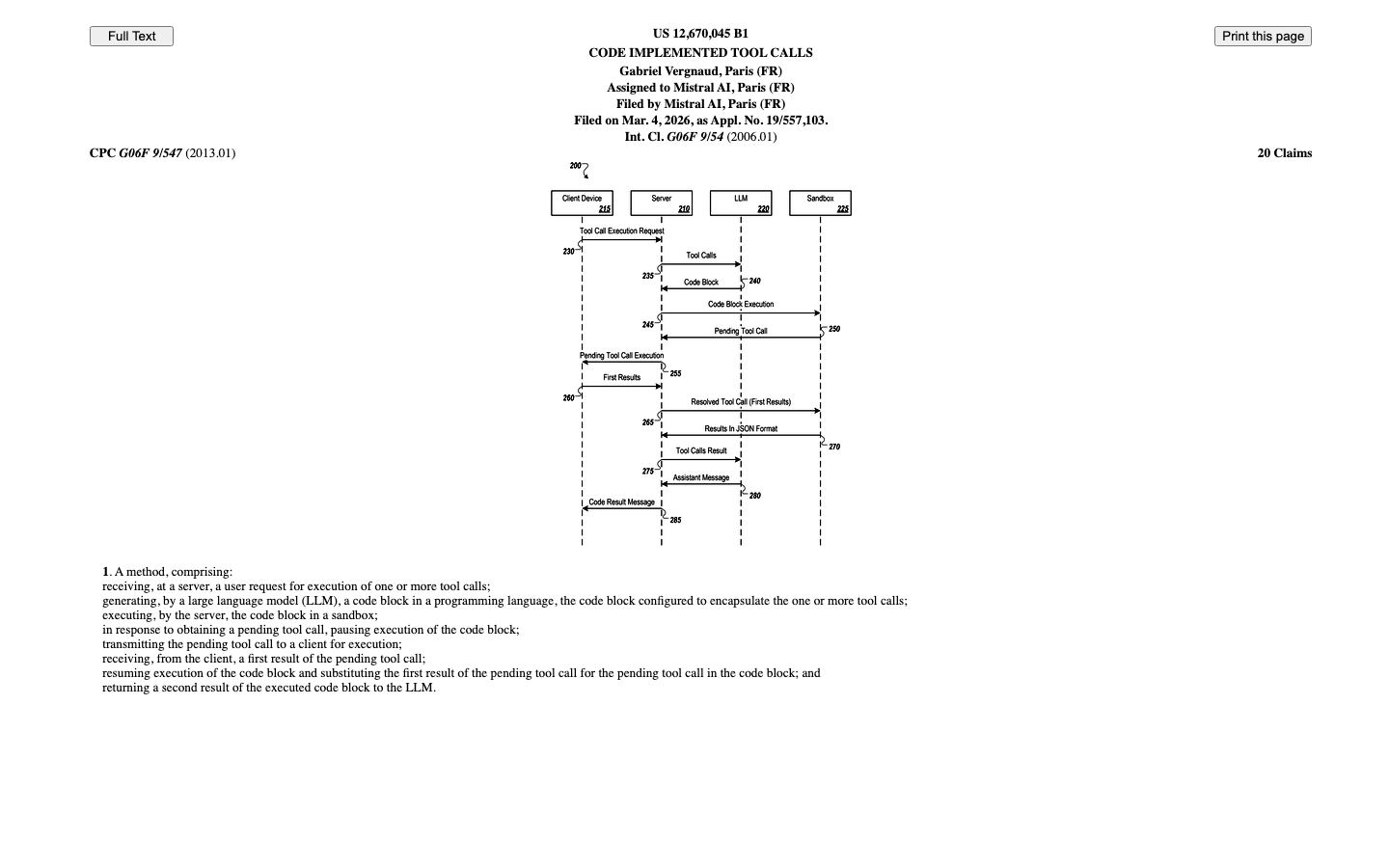
A method, comprising:
- Receiving, at a server, a user request for execution of one or more tool calls;
- Generating, by a large language model (LLM), a code block in a programming language, the code block configured to encapsulate the one or more tool calls;
- Executing, by the server, the code block in a sandbox;
- In response to obtaining a pending tool call, pausing execution of the code block;
- Transmitting the pending tool call to a client for execution;
- Receiving, from the client, a first result of the pending tool call;
- Resuming execution of the code block and substituting the first result of the pending tool call for the pending tool call in the code block; and
- Returning a second result of the executed code block to the LLM.
The core insight: instead of the model emitting JSON and the host dispatching, the LLM writes a program that is the tool call, the server runs it in a sandbox, and when the code hits a call that needs client-side execution (something the sandbox can’t or shouldn’t do — a browser action, a private API call, a UI interaction), the execution pauses, the call is sent to the client, and the result is substituted back in before resuming.
It’s a cooperative execution model: server-side sandbox for what can run there, client-side for what needs real-world context. The claim covers the pause/resume/substitute mechanics — which is narrower than “tool calling” in general, but broader than “JSON function calling” alone.
Why It Matters (Even If You Think It’s Obvious)
The patent’s significance is architectural. Today’s agents mostly use JSON function calling, which means:
- Every tool call requires a model round-trip (generate → dispatch → feed result back → generate again)
- The host needs a schema registry and a dispatch layer for every tool
- Long agentic chains are slow because of round-trip latency
Code-implemented tool calls collapse that: the model writes one program that performs many tool calls internally, and only pauses at genuine boundaries. That’s why the HN thread called it “just IPC” — conceptually, the pause/resume-over-a-boundary pattern is inter-process communication. But the combination with an LLM-generated code block is the claimed novelty.
The practical risk for developers: Mistral holds a granted patent (not just an application) on a mechanism that overlaps with how many agent frameworks already work — including Cloudflare’s Code Mode + MCP, and the general “model writes code, sandbox executes it” pattern. Whether it’s enforceable is another question (see prior art below), but granted patents on core agent plumbing are a new reality of the space.
The Prior Art Debate: What HN Surfaced
The thread’s most useful contribution was the prior-art hunt:
- rozenmd pointed to September 26, 2025: “https://blog.cloudflare.com/code-mode/” — Cloudflare’s Code Mode, which predates the March 2026 filing.
- abecedarius linked Cloudflare’s Code Mode + MCP blog (“note it predates the filing”).
- everforward described functionally similar prior art: “I can invoke a Python function that doesn’t exist and the exception gets handed off to an LLM to make it work by making that function exist… Invoke a tool that doesn’t exist, we’ll make it exist for you.”
- jazzyjackson gave the legal realist’s view: “Improvements in existing tech can be patented. An RPC call that an AI writes for itself and then executes is a novelty from prior art. Whether it’s non-obvious is up for debate but if it gets past the patent officer that debate happens via lawsuit.”
- williamcotton: “Or an Inter Partes Review!” — the post-grant challenge route.
- c7b: “This is a patent application from March, so a challenge should still be possible. But it would have to come from a named entity afaik (not a lawyer).” — plus preissuance observations anyone can file before grant.
- CodesInChaos summed up the systemic complaint: “Unfortunately there are many patents that simply combine an old thing with a new thing in the obvious way. Since the new thing is new, the combination is ‘novel’.”
Note: the patent is granted (B1 = granted patent, published June 30, 2026), though filed March 2026 — an unusually fast grant. The USPTO’s Preissuance Submission window (MPEP §1134) for third-party observations is now closed post-grant, but Inter Partes Review (IPR) and post-grant review routes remain open to parties with standing.
A Practical Workflow: Audit Your Tool-Calling Architecture
If you build agents, here’s a five-step way to assess exposure and design around the patent:
Step 1: Classify your tool-calling pattern
Map each of your agent loops: JSON function calling (OpenAI-style), code-interpreter style, or pause/resume-with-client-execution? Only the third overlaps the patent’s claim scope. Most current frameworks are in category 1 — low risk.
Step 2: Identify client-side pause/resume points
If you’re building a hybrid (code in sandbox + client round-trips), document where execution pauses and what crosses the boundary. That’s exactly the claimed combination.
Step 3: Check your prior art and dates
If you built a pause/resume tool-call system before March 4, 2026 with public evidence (blog posts, commits, changelogs), you have prior-art material. Cloudflare’s Code Mode (Sept 2025) is the strongest public anchor the HN thread found.
Step 4: Design for non-infringement where practical
Options: keep tool calls in JSON dispatch (no code-block encapsulation), keep execution fully server-side, or use client-side execution without the pause/resume substitution mechanics. Note that open-source and MCP ecosystems largely operate on a “patent holders rarely sue the community” assumption — but that’s a risk decision, not a legal certainty.
Step 5: Watch the enforcement pattern, not the claims
Mistral’s own ecosystem (Le Chat, Codestral, its agent SDKs) uses tool calling heavily. The realistic scenarios are (a) defensive use, (b) licensing leverage against competitors, or (c) nothing at all. The community reaction — from “just ipc” to “two ideas like this every toilet visit” — signals that the patent faces serious validity questions in any enforcement action.
The Bottom Line
US 12,670,045 is a granted patent on a specific mechanism: LLM-generated code blocks that encapsulate tool calls, executed in a sandbox with pause/resume around client-side execution. It’s not a patent on tool calling in general, and the prior-art record (Cloudflare Code Mode predating the filing, exception-handler-to-LLM patterns, plain IPC) makes its validity questionable. But it’s a useful forcing function: understand which tool-calling paradigm your agent stack uses, document your dates, and watch how Mistral deploys the patent. The HN verdict — “that is just ipc” — is probably right about the novelty, but “just IPC” is how broad software patents get litigated anyway. Document your own prior art now, before you need it.