Awesome Free AI Models 2026 — Complete Guide to Running AI Without Spending a Cent
The Free AI Revolution Is Here
Let’s cut through the marketing: in 2026, “free AI” usually means a capped trial or a teaser for a paid tier. But there’s a genuine ecosystem of free, open-weight, and freemium AI tools that are actually useful — no credit card required.
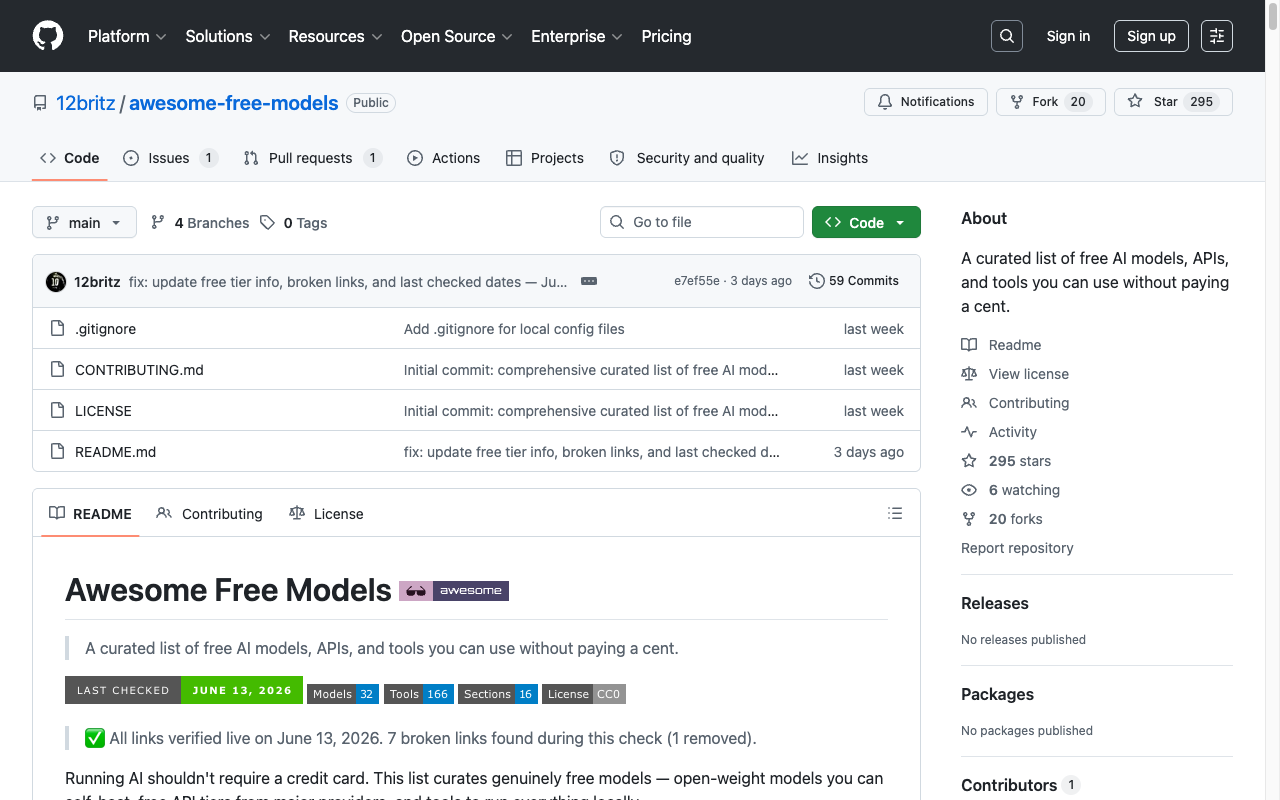
This guide is based on the Awesome Free Models curated list (295★, actively maintained, last verified June 13, 2026) combined with hands-on testing. We’ll cover 32+ models, 166+ tools, and 16 categories — all genuinely free.
What “Free” Actually Means in 2026
Before diving in, understand the three flavors of free:
| Type | Examples | Best For |
|---|---|---|
| Open-Weight Models | Llama 4, DeepSeek V4, Gemma 4 | Self-hosting — full control, zero cost beyond hardware |
| Free API Tiers | Google AI Studio, Groq, OpenRouter Free | Prototyping without local hardware |
| Free Tools | Ollama, LM Studio, Open WebUI | Running local models with minimal setup |
Most projects combine all three: use free API tiers for quick experiments, run open-weight models locally for sensitive work, and use free tools to bridge the gap.
16 Best Open-Weight Models You Can Run Today
The open-weight landscape has exploded in 2026. Here are the standout models worth your attention:
Frontier-Tier (High-End Hardware Required)
DeepSeek V4 Family DeepSeek’s latest generation offers extreme cost-efficiency under MIT license. The V4 Flash variant is particularly interesting — 1M token context, optimized for fast inference, and small enough to run on high-end consumer hardware. No restrictive licensing, no gated access.
Llama 4 Scout / Maverick Meta’s MoE generation. Scout (109B, 10M context) is the most impressive open-weight model for long-document tasks. Maverick (402B, 1M context) competes with GPT-5 on benchmarks. Both are natively multimodal. The license permits commercial use with some restrictions.
Gemma 4 (Google) Google’s fully permissive (Apache 2.0) family. The 31B dense model and 26B MoE variant offer 256K context with native multimodal capabilities. These set the new standard for permissively licensed open weights. Excellent for fine-tuning and commercial deployment.
Consumer Hardware-Friendly (Runs on 24GB+ GPU or Apple Silicon)
Qwen 3.6-35B-A3B This is the efficiency champion. 35B total parameters but only 3B active per token (MoE architecture). It runs on consumer GPUs and even high-end laptops. Apache 2.0 license, strong reasoning performance. If you have an RTX 4090 or M4 Max, start here.
Bonsai 8B (PrismML) Groundbreaking 1-bit quantized model. 8B parameters compressed to extreme efficiency — runs on Apple Silicon without compromise. Released April 2026, it’s the best option for edge devices and laptops.
Mistral Small 4 (119B, 6.5B active) Mistral’s latest hybrid MoE unifies instruction, reasoning, and multimodal capabilities. Apache 2.0 licensed. The 6.5B active parameter count means it’s surprisingly efficient for a 119B total model. Excellent for agentic workflows.
Specialized Models
Step 3.7 Flash (StepFun) May 2026 release. Apache 2.0, native multimodal (image + video), strong agentic performance. Efficient enough for high-end local hardware. The “Flash” moniker is earned — it’s one of the fastest open-weight models for inference.
Kimi K2.6 (Moonshot AI) 1T-parameter MoE with a modified MIT license. Exceptional coding performance (SWE-Bench ~54%) and multi-agent swarm orchestration. If you need a local model for software development, this is a top contender.
Command A+ (Cohere) May 2026. Enterprise multimodal MoE optimized for sovereignty and multilingual RAG across 48 languages. Apache 2.0. The standout for non-English applications.
5 Free API Providers (No Local Hardware Needed)
If you don’t have a GPU or just want to experiment fast:
1. Google AI Studio — The Most Generous Free Tier
2,000+ free requests per day on Gemini 2.5 Flash. 1M token context. No credit card required. Hands-down the best free API for prototyping. Supports multimodal input (images, audio, video, PDFs).
2. Groq — Fastest Free Inference
Ultra-low latency inference on Llama, Gemma, and Mixtral models. Free tier gives you generous daily rate limits. Perfect for chat applications where speed matters more than model size.
3. OpenRouter Free Models
Aggregates 500+ models from 20+ providers. Filter by “Free” to see available zero-cost options. The free tier includes experimental and subsidized open-weight models. One API key for everything.
4. Hugging Face Inference API
Free tier for thousands of community models. Rate-limited but excellent for testing any model in the Hugging Face ecosystem without downloading. Good for A/B testing different architectures.
5. NVIDIA NIM
Free API access to accelerated versions of popular models. Requires a free NVIDIA account. Good for GPU-accelerated inference without owning a GPU.
Essential Free Local Tools
Ollama — The Swiss Army Knife
Still the most popular local LLM runner. Supports virtually every open-weight model through Modelfiles. One-command setup: ollama run deepseek-v4-flash. GGUF support means it runs on CPU (slowly) or GPU (fast).
LM Studio — For Discovery and Chat
Better UI than Ollama for browsing and testing models. Built-in model browser, chat interface, and local API server. Excellent for non-technical users who want to try models without the command line.
Open WebUI — ChatGPT-Like Interface for Local Models
Formerly Ollama Web UI. Full-featured chat interface with RAG support, multi-user mode, and tool integrations. If you want a ChatGPT experience with local models, this is it.
Continue.dev — AI Coding with Local Models
IDE extension (VS Code, JetBrains) that works with local Ollama/LM Studio models. For tab completion, chat, and inline editing — all with models running on your machine. No cloud dependency.
How to Get Started: A 10-Minute Quick Start
# Install Ollama
curl -fsSL https://ollama.com/install.sh | sh

# Run your first model (3B active parameters, runs on any modern laptop)
ollama run qwen3.6:35b-a3b

# Or try the efficiency champion for Apple Silicon
ollama run bonsai-8b
For the free API path:
- Go to Google AI Studio (no credit card)
- Get an API key
- Start coding with
curlor any OpenAI-compatible SDK
curl -X POST "https://generativelanguage.googleapis.com/v1beta/models/gemini-2.5-flash:generateContent?key=$API_KEY" \
  -H "Content-Type: application/json" \
  -d '{"contents":[{"parts":[{"text":"Explain quantum computing in 3 sentences"}]}]}'
Use Case: Build a Free Coding Assistant
Combine all three layers:
- Model: Qwen 3.6-35B-A3B (runs on consumer GPU)
- Runner: Ollama (one-command setup)
- IDE Integration: Continue.dev (connects to Ollama)
Total cost: $0. Total setup time: 15 minutes. You get:
- Tab completion as you type
- Chat-based code generation
- Inline editing
- Full privacy (everything runs locally)
The Verdict
The “free AI” landscape in 2026 is genuinely impressive. DeepSeek, Qwen, and Gemma models offer capabilities that would have cost thousands in API fees just 18 months ago. The tools ecosystem (Ollama, LM Studio, Open WebUI) has matured to the point where non-technical users can run state-of-the-art models locally.
The landscape has shifted: you no longer need a cloud subscription to access frontier AI capabilities. The question isn’t “is there a free option” — it’s “which free option is best for your specific use case.”
Quick Decision Matrix
| If you… | Start with… | Why |
|---|---|---|
| Have no GPU | Google AI Studio | Best free API tier |
| Have an M-series Mac | Qwen 3.6 + Ollama | Runs locally, great performance |
| Have an RTX 4090 | DeepSeek V4 Flash | 1M context, MIT license |
| Want coding assistance | Continue.dev + any local model | Free, private, works offline |
| Need enterprise features | Command A+ (Cohere) | Apache 2.0, multilingual, sovereign |
| Just want to experiment | OpenRouter Free | One API, 500+ models, zero cost |