OpenRouter vs Direct Provider APIs vs LiteLLM 2026 — After the $7B Stripe Acquisition
Quick Verdict
On August 16, 2026, Bloomberg reported that Stripe is clinching a deal to buy OpenRouter for over $7 billion — the AI-equivalent-of-Stripe becoming literally Stripe. OpenRouter raised at a $1.3 billion valuation a few months earlier, per Aurornis’s comment citing the NYTimes figure, making this a ~5x exit in months. The deal matters to every developer using OpenRouter’s single API key to reach hundreds of models, because the questions it raises are immediate and practical: does pricing change, does the free-model tier survive, do the traces get monetized, and should you migrate to direct provider APIs or a self-hosted gateway like LiteLLM?
Our take after working through the pricing structures, the feature surface, and the HN thread (93 points, 17 comments — but unusually dense with informed takes): OpenRouter is still the lowest-friction way to evaluate and switch between models in 2026, the acquisition is a liquidity event for a company whose business model (aggregation + convenience fee) is exactly Stripe’s, and the risk is not “Stripe will jack up prices” — it’s strategic repricing, trace monetization, and support neglect, which the community already flagged before the deal.
Community pulse: the thread’s sharpest exchange was the “why is a middleman worth $7B?” debate. Gecko4072 noted $7B exceeds the market cap of Lyft, Dolby, and Alaska Airlines; kelnos pushed back that addressable market and liability profiles are incomparable; codybontecou supplied the most concrete bull case: “LLM traces are supposedly very valuable. I imagine OpenRouter has one of the most extensive and diverse set of traces in the world.” The counterweight came from code51 — “OpenRouter should first fix their support. No support exists when things go wrong!” — and skeledrew: “Historically acquisitions have never really been good for customers.”
What Actually Happened
- The deal: Stripe agrees to acquire OpenRouter for over $7 billion (Bloomberg, August 16, 2026). Not yet closed at time of writing.
- The pre-history: OpenRouter already uses Stripe for payments —
closetheloopdevlinked Stripe’s own newsroom page (“Stripe powers OpenRouter’s global AI model access for millions of developers”) as the deal’s announcement. The acquisition is a customer-becomes-subsidiary story. - The valuation math: ~$1.3B private valuation → $7B+ exit in roughly two months (per NYTimes-reported figure quoted in the thread).
- The strategic read:
porridgeraisinsummarized it in one line: “Both are in the business of putting a single API key in front of a fragmented ecosystem and charging a convenience fee. This middleman business is naturally coalescing.”
What OpenRouter Actually Is (and Isn’t)
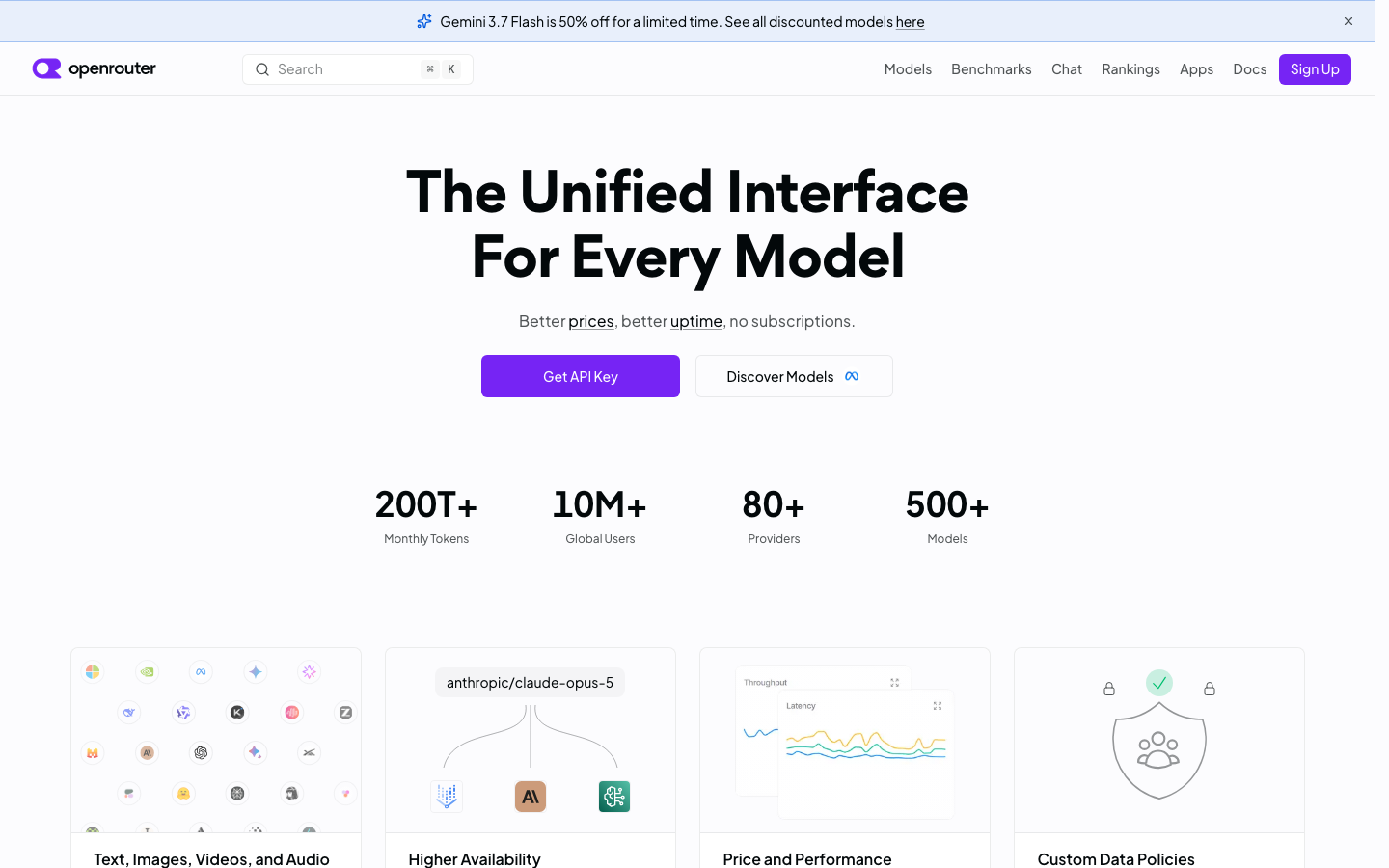
Before comparing, the correction that dominated the thread: OpenRouter is a proxy, not an automatic router. bensyverson: “Rather than building API clients for five different AI providers, you build one client to OpenRouter, and switching models become extremely easy.” The user picks the model; OpenRouter provides unified billing, fallbacks, and routing infrastructure. simonw noted that automatic model routing exists mainly as “a cost optimization, since tokens for the best models have got expensive once you start piping millions of tokens through them.”
The 2026 feature surface (from OpenRouter’s own docs) is substantial for an aggregator: Workspaces with budgets, model fallbacks, provider selection, Zero Completion Insurance, Service Tiers (Standard/Priority), response caching, structured outputs, and Sovereign AI (regional routing). Pricing is credits-based: top up credits, spend them on any model, with provider prices plus OpenRouter’s convenience fee, and a tier of free (provider-subsidized, rate-limited) models.
The Comparison: Three Ways to Reach Many Models
Dimension 1 — Pricing structure
| Approach | Pricing model | Free tier | Cost control |
|---|---|---|---|
| OpenRouter | Credits; provider price + convenience fee per call | Yes — rate-limited free models (e.g., DeepSeek variants) | Workspace budgets, per-model limits, fallback budgets |
| Direct provider APIs | Per-provider invoicing, pay-as-you-go | Provider-dependent (some offer trial credits) | Per-provider dashboards; you manage each account |
| LiteLLM (self-hosted) | Gateway is open source (free); you pay providers directly | Whatever your providers offer | Full control — your own budgets, routing rules, logging |
The key structural fact: OpenRouter’s free models are provider-controlled, not OpenRouter-controlled. When HN user nannal mourned “RIP free deepseek access,” minimaxir corrected: “Free model usage is controlled by the LLM provider, not OpenRouter. Both parties have their own incentives to allow it and that would not change with different owners.” Free DeepSeek depends on data-sharing arrangements with Chinese providers — an acquisition doesn’t automatically kill it, but the data-sharing incentives are exactly what a new owner might renegotiate.
Dimension 2 — Model access and switching
| Approach | Model count | Switching cost | New-model latency |
|---|---|---|---|
| OpenRouter | Hundreds of models, one key, OpenAI-compatible | Near zero — change the model string | Hours-to-days for new releases |
| Direct provider APIs | One provider’s catalog per key | New client, new key, new billing per provider | Immediate for that provider |
| LiteLLM (self-hosted) | Whatever you configure (any provider) | Add a provider config to your gateway | Depends on your provider integrations |
minimaxir’s point is the one that matters most in 2026: “OpenRouter is the best way to use [good/cheap Chinese models] without jumping through a ton of hoops.” The Chinese-model wave (DeepSeek, Qwen, GLM, Kimi) is precisely the fragmentation scenario OpenRouter was built for — and precisely the scenario where a Stripe-owned aggregator with payment infrastructure has structural advantages.
Dimension 3 — Data, privacy, and control
| Approach | Who sees your prompts | Data governance | Control surface |
|---|---|---|---|
| OpenRouter | OpenRouter proxy + the chosen provider | OpenRouter logging policy; provider logging varies | Workspaces, budgets, service tiers, sovereign routing |
| Direct provider APIs | The provider only | Your contract with the provider | Provider’s native controls |
| LiteLLM (self-hosted) | Your configured providers only | Your own logging/retention entirely | Complete — custom routing, redaction, caching |
This is where codybontecou’s traces point cuts both ways. LLM traces (prompt/response pairs across hundreds of models) are “one of the most extensive and diverse set of traces in the world” — the single most valuable asset in the deal, and simultaneously the thing privacy-sensitive teams should worry about. Teams with strict data-governance requirements were already steering toward self-hosted gateways or direct contracts; the acquisition strengthens that argument.
Dimension 4 — Reliability, support, and business risk
| Approach | Support | Uptime | Acquisition/post-2026 risk |
|---|---|---|---|
| OpenRouter | Community + ticket-based; repeatedly criticized | Generally good; single point of failure | High — new owner, repricing, trace monetization, free-tier terms |
| Direct provider APIs | Provider SLAs, enterprise support | Provider-grade | Low — you’re already at the source |
| LiteLLM (self-hosted) | Community/self-support | Your own infra | Low — open source, no vendor dependency |
The support critique is pre-existing and public: code51’s “No support exists when things go wrong!” got no rebuttal in the thread. And skeledrew’s exit calculus is worth quoting in full: “Historically acquisitions have never really been good for customers. Time for me to look for an OpenRouter alternative? At least they’re also as easy to switch from as the model providers they proxy.” The irony is real: OpenRouter’s own value proposition (zero switching cost) is what makes leaving it cheap.
Who Should Do What Right Now
Stay on OpenRouter if: you’re an individual developer or small team evaluating models frequently, you rely on the free tier for experimentation, or you want one invoice and one key across Chinese and Western models. The switching cost of leaving is near zero because of the product — so there’s no urgency to pre-emptively migrate.
Move to direct provider APIs if: you’ve already settled on one primary provider, you have enterprise data-governance requirements, or you need provider-grade support and SLAs. The cost of the middleman fee is real at scale.
Move to LiteLLM (or another self-hosted gateway) if: you pipe serious volume through multiple providers and want full control over routing, budgets, logging, and redaction — the exact capabilities OpenRouter’s docs list as its differentiators, now yours to run.
Everyone should: watch the deal close, watch for three signals — (1) changes to the free-model tier terms, (2) any per-call fee restructure, and (3) public statements about trace data usage. Any of the three moving = the moment to re-run this comparison with your actual token volumes.
FAQ
Q: Is the Stripe–OpenRouter deal confirmed? A: Bloomberg reported on August 16, 2026 that Stripe is clinching the deal at over $7 billion, and Stripe’s newsroom published a page titled “Stripe powers OpenRouter’s global AI model access for millions of developers.” The deal had not formally closed at time of writing.
Q: Will OpenRouter prices go up? A: Unknown. OpenRouter’s pricing is credits-based: provider price plus a convenience fee, with provider-controlled free tiers. The risk is strategic repricing under new ownership, not immediate rate changes. Watch for term-sheet announcements post-close.
Q: Does the acquisition affect the free DeepSeek models? A: Not automatically. Free models are provider-subsidized and controlled by the LLM providers (some require data sharing). A new owner can renegotiate those arrangements, but the acquisition alone doesn’t change them — see minimaxir’s correction in the HN thread.
Q: Is OpenRouter an automatic model router? A: No — it’s a proxy with optional routing features. You pick the model; OpenRouter unifies the API surface, billing, fallbacks, and provider selection. Automatic routing exists mainly as a cost-optimization experiment, per Simon Willison.
Q: What makes the company worth $7B if it’s “just a middleman”? A: Distribution and data. Hundreds of models behind one key, with vendor-approval friction removed for enterprises, plus the industry’s most diverse prompt/response trace corpus — the asset codybontecou flagged in the thread. Skeptics note the number is inflated by AI-market multiples (Cursor sold for $60B by comparison).
Q: What’s the cheapest way to keep using many models without OpenRouter? A: LiteLLM as a self-hosted gateway, with direct provider API keys. You pay providers at list price, no convenience fee, and you control routing and logging. The cost is operational: you maintain the gateway, the provider integrations, and the fallback logic yourself.
Verdict
The $7B Stripe–OpenRouter deal is a textbook middleman acquisition: the payment processor that already handled OpenRouter’s money buying the API aggregator that monetizes the same convenience-fee logic, with the industry’s most valuable trace corpus as the strategic prize. For developers, the practical verdict is calm: OpenRouter’s own design philosophy — zero switching cost — is what protects you. The deal only becomes your problem if three things move: free-tier terms, per-call pricing, or trace-data policy. Set a reminder to re-check those after close, keep your provider keys warm, and treat LiteLLM as your pre-staged exit. In 2026’s model landscape, the one thing nobody should do is build an integration that can’t switch providers in an afternoon — because that’s the only real risk in this deal.