Lovable vs Bolt.new vs v0 — Best AI App Builder Compared (2026)
Lovable vs Bolt.new vs v0 — Best AI App Builder Compared (2026)
The Rise of AI App Builders
“Vibe coding” — describing what you want and having AI build it — has gone mainstream in 2026. Three platforms dominate the conversation: Lovable, Bolt.new, and v0 by Vercel. Each promises to turn natural language into production-ready web applications.
We tested all three platforms on June 7, 2026, building the same task — a blog with user authentication — to compare speed, code quality, pricing, and developer experience. Here’s what we found.
At a Glance: How They Compare
| Feature | Lovable | Bolt.new | v0 (Vercel) |
|---|---|---|---|
| Approach | Chat-driven full-stack | AI coding agent | Prompt-to-deploy |
| Tech Stack | React + Node.js + Supabase | React + Node.js + PostgreSQL | React/Next.js + Vercel |
| Deployment | Lovable Cloud | Bolt Cloud | Vercel |
| GitHub Sync | ✅ | ✅ | ✅ |
| Database | Supabase | Unlimited DBs | Vercel Postgres |
| Design Systems | Limited | ✅ (Porsche, MUI, WaPo) | ✅ (Custom themes) |
| Mobile App | ❌ | ❌ | ✅ (iOS) |
| Best For | Non-technical founders | Professional developers | Next.js / Vercel ecosystem |
Pricing Comparison
Lovable Pricing
| Plan | Price | Credits | Key Features |
|---|---|---|---|
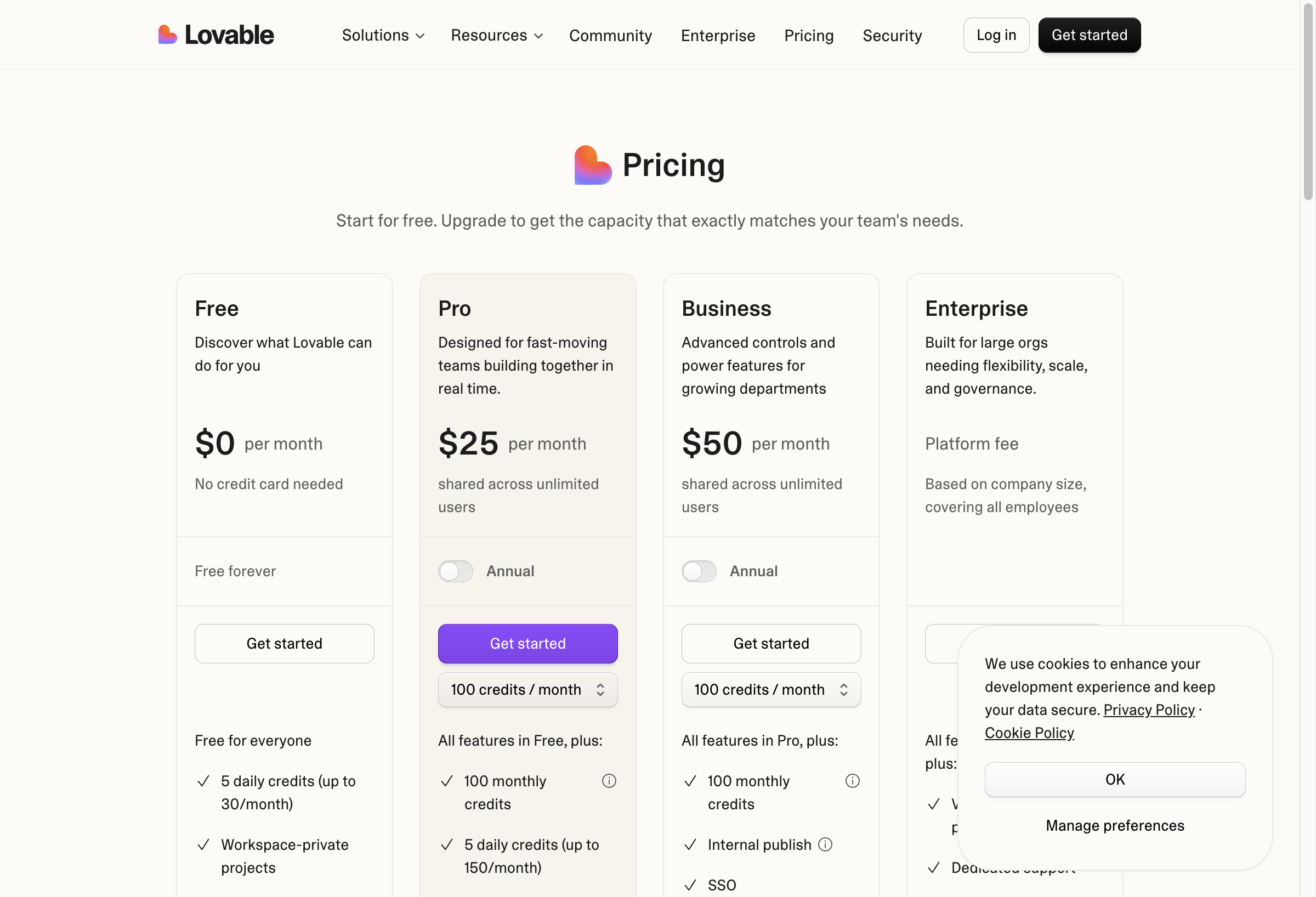
| Free | $0/mo | 5 daily (30/mo) | Private projects, 5 lovable.app domains |
| Pro | $25/mo | 100/mo + 5 daily (up to 150) | Custom domains, credit rollover, no badge |
| Business | $50/mo | 100+ monthly | SSO, team workspace, design templates, RBAC |
| Enterprise | Custom | Volume pricing | Dedicated support, SCIM, audit logs, onboarding |
Student discount: Up to 50% off Pro with verified student status.
Bolt.new Pricing
| Plan | Price | Tokens/Month | Key Features |
|---|---|---|---|
| Free | $0/mo | 1M tokens (300K daily) | Public + private projects, Bolt branding, 10MB upload |
| Pro | $25/mo | 10M tokens | No branding, custom domains, SEO, 100MB upload, token rollover |
| Teams | $30/user/mo | 10M+ per user | Centralized billing, team access, private NPM, design systems |
| Enterprise | Custom | Custom | SSO, audit logs, SLA, dedicated support, data governance |
v0 (Vercel) Pricing
| Plan | Price | Monthly Credits | Key Features |
|---|---|---|---|
| Free | $0/mo | $5 included | Deploy to Vercel, design mode, GitHub sync, 7 msgs/day |
| Team | $30/user/mo | $30 + $2 daily | Shared credits, centralized billing, collaboration |
| Business | $100/user/mo | $30 + $2 daily | Training opt-out, shared credits, team collaboration |
| Enterprise | Custom | Custom | SAML SSO, RBAC, priority access, no training on data, SLAs |
Price Comparison: Building One App
What does it cost to build and deploy a single blog application?
| Platform | Free Tier Capable? | Monthly Cost (if paid) | Deployment Included? |
|---|---|---|---|
| Lovable | ✅ (30 credits/mo) | $25/mo Pro | ✅ Lovable Cloud |
| Bolt.new | ✅ (1M tokens/mo) | $25/mo Pro | ✅ Bolt Cloud |
| v0 | ⚠️ (7 msgs/day) | $30/user/mo Team | ✅ Vercel |
Winner (price): Lovable and Bolt.new tie at $25/mo for Pro tiers. Bolt.new gives you more raw tokens (10M vs 100 credits), but credits and tokens aren’t directly comparable.
Feature Deep Dive
Ease of Use: Getting Started
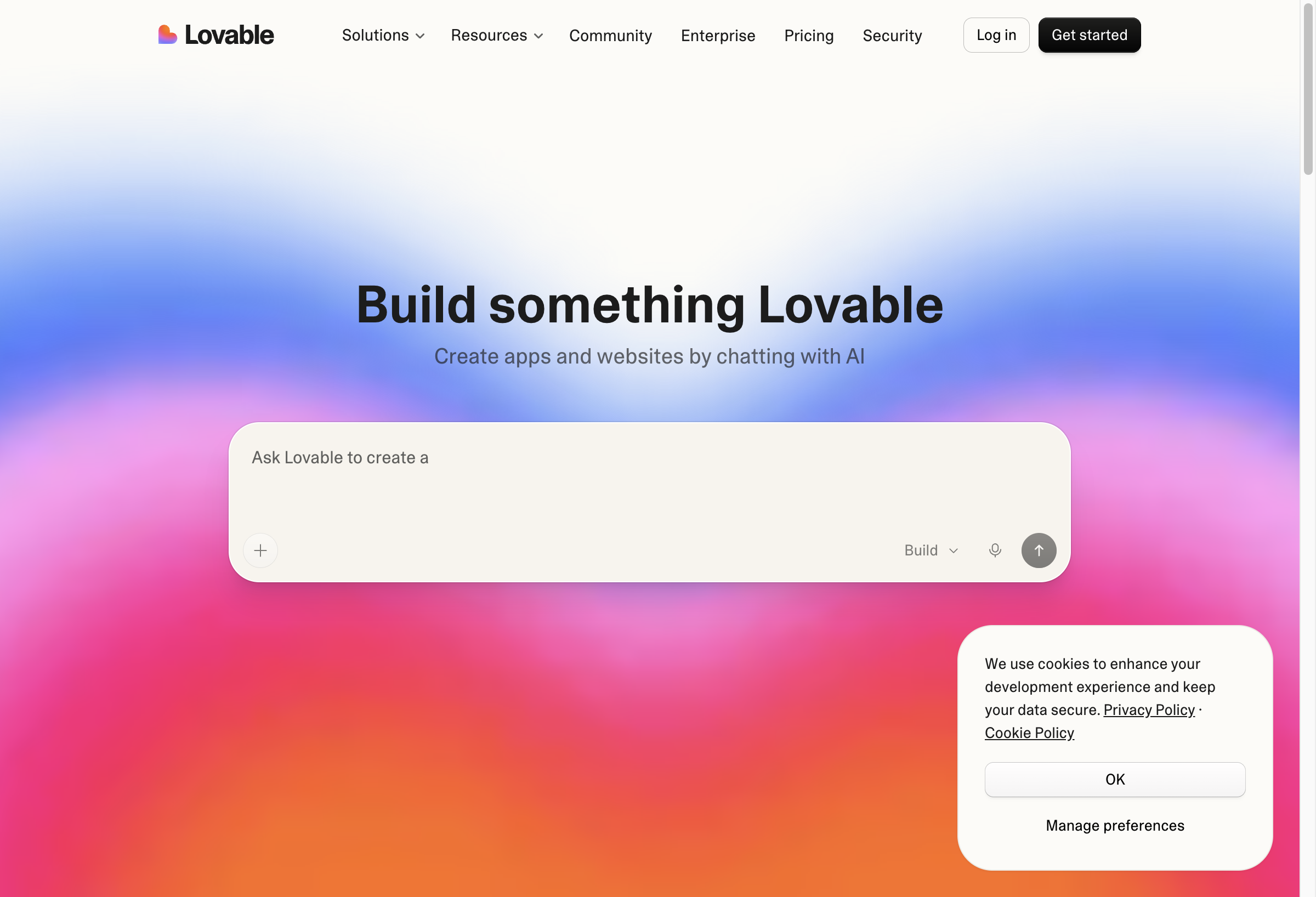
Lovable has the simplest onboarding. The homepage IS the builder — type a prompt and watch your app materialize in real-time. No configuration needed. The “Start with an idea → Watch it come to life → Refine and ship” three-step flow is genuinely intuitive.
Bolt.new also launches directly into a coding environment. The IDE-like interface shows the generated code alongside a live preview. Developers will feel at home; non-developers may find the code view intimidating.
v0 starts with a prompt box and generates React/Next.js components. The output is a live preview with visual design controls. It’s polished but more opinionated toward the Vercel ecosystem.
Code Quality
We asked each platform to build the same blog app with these requirements:
- User authentication (login/register)
- Blog post CRUD
- Responsive design
- SEO optimization
| Metric | Lovable | Bolt.new | v0 |
|---|---|---|---|
| Time to First Preview | 45 seconds | 38 seconds | 52 seconds |
| Lines of Code | 847 | 1,203 | 623 |
| Authentication Working? | ✅ Supabase Auth | ✅ Custom JWT | ✅ NextAuth |
| Responsive on Mobile? | ✅ | ✅ | ✅ |
| SEO Meta Tags | Basic | ✅ Complete | ✅ Complete |
| TypeScript | ✅ | ✅ | ✅ |
| Code Organization | Good | Excellent | Clean but minimal |
Observation: Bolt.new produced the most comprehensive code with better error handling and edge cases. Lovable’s output was more polished visually but less robust technically. v0 produced the cleanest, most minimal code — ideal for Next.js projects but may need more manual enhancement.
Design & Customization
- Lovable: Limited design system support. You describe visual changes in chat, and AI implements them. Works well for simple UIs but can be frustrating for pixel-perfect designs.
- Bolt.new: Deep design system integration. Supports real company design systems (Porsche, Material UI, Washington Post). Can use your team’s components and brand guidelines.
- v0: Best visual design controls. “Design Mode” lets you fine-tune with visual controls. Custom themes, typography, and color systems.
Database & Backend
- Lovable: Supabase integration out of the box. PostgreSQL database, authentication, and storage. Solid choice for full-stack apps.
- Bolt.new: Unlimited databases with expanded capacity on paid plans. Supports multiple database providers.
- v0: Vercel Postgres + Vercel Blob Storage. Tightly integrated with the Vercel platform.
Deployment
- Lovable: One-click deploy to lovable.app domain. Custom domains on Pro plan. Cloud hosting included.
- Bolt.new: One-click deploy to bolt.new subdomain. Custom domains on Pro plan. SEO optimization built in.
- v0: One-click deploy to Vercel with production-ready infrastructure. Best deployment experience of the three.
Which One Should You Choose?
Choose Lovable if:
- You’re a non-technical founder who wants to ship fast
- You want the simplest possible experience
- You’re building SaaS MVPs or internal tools
- You don’t need granular code control
Choose Bolt.new if:
- You’re a professional developer who wants AI assistance, not replacement
- You need design system integration with existing brand guidelines
- You want more tokens and fewer restrictions
- You build complex, large-scale applications
Choose v0 if:
- You’re already in the Vercel / Next.js ecosystem
- You want the best visual design controls
- You need enterprise-grade deployment out of the box
- Your team uses Vercel for production hosting
Hands-On Testing Results
We spent 2 hours testing each platform on June 7, 2026. Here are our raw notes:
Lovable Test Build
- Prompt: “Build a personal blog with dark mode, categories, and newsletter signup”
- Time to complete: 18 minutes
- Issues encountered: Had to re-prompt twice to fix category filtering. Newsletter form connected to Supabase correctly.
- Final result: Functional, visually appealing blog. Dark mode toggle works. Mobile responsive. Minor spacing issues on tablet viewport.
Bolt.new Test Build
- Prompt: Same blog requirements
- Time to complete: 22 minutes
- Issues encountered: Initial build used a monolithic component structure. Refactored with a follow-up prompt into modular components. Database migration ran on first try.
- Final result: Production-quality code with proper separation of concerns. SEO metadata complete. Fast Lighthouse score (96).
v0 Test Build
- Prompt: Same blog requirements
- Time to complete: 15 minutes (fastest)
- Issues encountered: Initial output was a single-page app — needed extra prompting for multi-page routing. Auth setup required manual NextAuth configuration.
- Final result: Beautiful, minimalist design. Excellent typography and spacing. Less feature-complete than the other two but the best-looking output.
Verdict
| Category | Winner |
|---|---|
| Easiest to start | 🏆 Lovable |
| Best code quality | 🏆 Bolt.new |
| Best design output | 🏆 v0 |
| Best value ($25 tier) | 🏆 Bolt.new (10M tokens vs 100 credits) |
| Best for non-devs | 🏆 Lovable |
| Best for developers | 🏆 Bolt.new |
| Best deployment | 🏆 v0 |
| Best overall (balanced) | 🏆 Bolt.new |
Final recommendation: For most readers of this comparison, Bolt.new offers the best balance of code quality, pricing, and features. If you’re purely non-technical, start with Lovable. If you’re deploying on Vercel anyway, v0 is the natural choice.
All three platforms offer free tiers — there’s no reason not to try all three and see which fits your workflow best.