Cursor Origin vs GitHub 2026 — Can an AI Editor Company Replace the World's Largest Code Host?
Quick Verdict
On August 17, 2026, Cursor announced Origin, its own code-hosting platform — repos, pull requests, code browsing, and two-way GitHub sync — rolling out in early beta to all paid plans. The timing was deliberate: GitHub had just endured a high-profile outage wave, and Hacker News had spent weeks debating whether Microsoft’s Azure capacity crunch was degrading GitHub reliability.
The Hacker News thread (418 points, 330 comments) split into two camps almost instantly: developers who want “a GitHub that stays up,” and developers who will not trust any code host owned by Elon Musk’s xAI after the Grok Build repo-upload incident. Both arguments have real evidence behind them.
The bottom line: Origin today is a feature-parity GitHub clone with two differentiators — agents built into every repo and two-way PR sync that bridges to GitHub instead of forcing a migration. It is not yet a reason to leave GitHub, but it is a credible hedge. If you already pay for Cursor Pro, there is no cost to try it.
Why Origin Exists: The GitHub Reliability Window
The launch did not happen in a vacuum. GitHub has been fighting scaling pressure all year as AI-generated commit volume exploded. In the launch thread, chris_money202 summarized the prevailing theory:
“GitHub is crashing due to scaling pressure… Once Azure’s massive spend is online things will slowly get better.”
0xy countered with a different read: “They’re actually ramping back up on AWS after Azure failed to scale to their needs. They planned to be fully off AWS in 2027 but they’re continuing to ramp usage.”
Whatever the root cause, the perception gap is real. peterldowns, a paying GitHub customer, said:
“The idea is that it’s like Github but it stays up even as your commit/CI frequency increases. As a customer I’m stoked and looking forward to fully switching over as that’s exactly what I want.”
That single comment captures Origin’s entire go-to-market thesis: developers are not leaving GitHub because they want to — they are leaving because of outages.
What Origin Actually Ships (Early Beta)
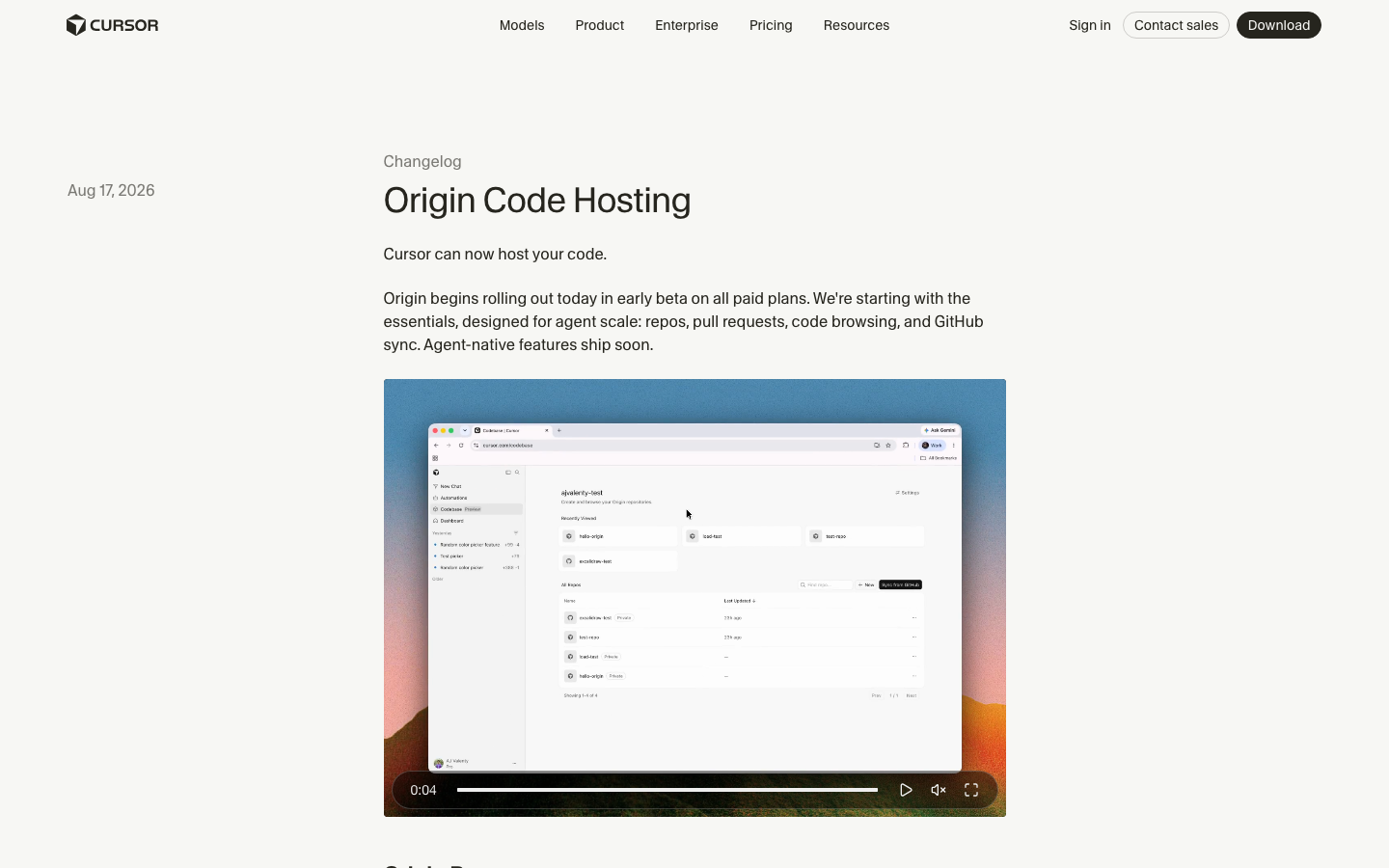
The changelog (published August 17) is honest about scope: “We’re starting with the essentials, designed for agent scale: repos, pull requests, code browsing, and GitHub sync.”
1. Origin Repos
A new Codebase tab in Cursor hosts repos natively. cursor.com/codebase/<your-name> becomes the URL namespace. Push a local project with the Origin CLI and it is hosted on Origin — no GitHub in the path.
2. Two-Way GitHub Sync
This is the smart part. Rather than forcing migration, Origin pulls in any GitHub repo you select:
- Synced repos update in real time — browse, search, and pull from the Origin copy.
- Pushes still go to GitHub, which “stays the source of truth for anything started there.”
- PR comments sync both ways: comment in Cursor and it posts to GitHub; react or reply on GitHub and it appears in Cursor “within seconds.”
- You can disconnect a repo at any time. Icons distinguish Cursor-hosted repos from synced ones.
justincormack noted the implication: “It seems to have 2 way sync of PRs, issues, issue comments etc, so it must be pretty much the same data model, so they could probably have a compatible API.” An API-compatible surface would massively reduce lock-in risk for tooling built on GitHub’s API.
3. Pull Requests
Standard PR surface: timeline, commits, checks, files changed, inline diff comments, merge. Reviews assigned on GitHub can be reviewed and merged from Cursor.
4. Agents in Every Repo
The actual differentiator. “Your code, PRs, and agents are now in the same place. Ask Cursor questions about code you’re browsing. It can answer, make changes, update PRs, or push a branch.” This is what “GitHub for agents” means in practice — the agent does not need a checkout, a PAT, or a CI bridge to act on a repo.
5. App Extensions
An app ecosystem is live at launch: Vercel (preview deployments per PR), Depot, and Buildkite (both run existing GitHub Actions workflows; Buildkite also runs native pipelines). More coming.
6. The Roadmap (Agent-Native Source Control)
Origin’s developer lead is Tomas Reimers, co-founder of Graphite (the stacked-PR tool Cursor acquired). In the thread he was unusually direct about the roadmap:
“We wanted to release a beta so people could start experimenting with our scalability and extensibility themselves. Over the next few weeks, you can expect a handful of features starting to change source control to better understand and work with agents.”
And in response to “what’s the biggest differentiator to GitHub?”:
“Today, very little. We’re intentionally releasing this as a Github alternative where we meet them toe-to-toe on functionality. Over the next few weeks you can expect a lot more from us on integrations with agents, understanding agent-written code (without having to read through all of the code), and automatically getting your PRs to a mergable state.”
That is the honest version of the pitch: today, parity; next month, agent-native.
Comparison: Origin vs GitHub vs GitLab
| Dimension | Cursor Origin (beta) | GitHub | GitLab |
|---|---|---|---|
| Hosting model | Cursor infra (early beta) | Azure + AWS hybrid | Cloud or self-hosted |
| AI integration | Agents in every repo; agent-write-PR roadmap | Copilot (separate product); Copilot Autofix on PRs | GitLab Duo (separate product) |
| PR sync | Two-way with GitHub | Native | Native; GitHub import one-way |
| CI/CD | Depot / Buildkite / Vercel apps (GitHub Actions workflows supported) | GitHub Actions | Built-in CI/CD |
| Pricing | Included in Cursor paid plans (Hobby free, Pro $20/mo, Pro+ 3× limits, Ultra 20×, Teams $40/user/mo) | Free / Pro $4/mo / Team $21/user/mo | Free / Premium $29/user/mo |
| Self-host | No | No (GHES is managed) | Yes (CE/EE) |
| Migration friction | Zero for synced repos (GitHub stays source of truth) | n/a | Import tools exist |
| Trust posture | xAI/Musk ownership; Grok Build repo-upload incident | Microsoft | Independent-ish (public company) |
The Trust Question: The Real Differentiator HN Couldn’t Stop Debating
Origin’s biggest problem is not technical — it is the parent company. Cursor was acquired by xAI, and the thread repeatedly brought up the July 2026 incident where Grok Build uploaded entire repositories — including .env files — to xAI storage without permission (covered by The Hacker News, linked repeatedly in the thread).
dbbk put it bluntly:
“Given Grok was just caught uploading whole codebases and sensitive .envs without permission, how can anyone possibly trust this?”
BryantD:
“I think there are a large number of people I’d trust with my code before Musk… xAI was caught uploading any repo their coding agent touched to their storage only last month. This isn’t about Musk’s ideology: it’s about his trustworthiness.”
Supporters noted the mitigations (vorticalbox: “They acknowledged that it happened, fixed the bug that caused it, deleted all data that was uploaded”) and asked for consistency (gjsman-1000: “Given Claude was just caught hacking companies as it pleased, how can anyone possibly trust this?”).
The thread’s most balanced take came from pseudosavant:
“There aren’t examples of OpenAI, Anthropic, or GitHub/Microsoft doing the sketchy things that xAI has been involved with. Those companies care a lot about the reputational damage that would come from flouting their customer’s data privacy obligations.”
Practical read: for public repos, trust concerns are mostly moot. For private/enterprise code, Origin’s SOC 2 posture, data-use terms, and whether xAI training can touch hosted code are unanswered questions that will decide enterprise adoption. Cursor’s own changelog markets “SOC 2 Certified,” but HN users noted the TOS had no clear “will my code end up in Grok?” answer at launch time.
The Irony: GitHub Degradation Hit Origin Within Hours
A second HN story (66 points, 25 comments) reported that GitHub degradation affected Cursor Origin — its new Git platform — within a day of launch, per status.cursor.com/incidents/l9h9vrd726jv. If Origin’s pitch is “GitHub that stays up,” then depending on GitHub for sync means inheriting GitHub’s failure modes, at least in the beta period. For synced repos, that is by design — GitHub remains the source of truth. For Origin-hosted repos, the incident is a reminder that a two-day-old platform has no uptime track record yet.
Who Should Use Origin
Try it now (zero cost):
- Cursor Pro/Pro+/Ultra subscribers who want PR review and merge inside the editor.
- Teams that already live in Cursor and want agents to act on repos without checkouts.
- Anyone tired of GitHub outages who wants a zero-friction escape hatch — synced repos keep GitHub as source of truth, so there’s no migration risk to experiment.
Wait and watch:
- Enterprises with strict data policies — until the data-use terms are explicit about xAI training and the root-cause analysis of the Grok Build incident is public.
- Heavy GitHub API tooling users — until Origin confirms API compatibility (two-way sync suggests it, but it is unconfirmed).
- Self-hosting advocates — Origin has no self-host option; GitLab or Gitea remain the choice there.
The 3-Month Watchlist
- Agent-native features: Reimers promised “understanding agent-written code without reading all of it” and “automatically getting your PRs to a mergable state.” If those ship in weeks, Origin becomes the first host built around agent workflows rather than bolting AI onto GitHub’s model.
- Uptime record: Origin-hosted (non-synced) repos need a clean 90 days to counter the degradation incident.
- Data-use terms: Whether Origin-hosted code is excluded from xAI training is the single question that decides enterprise adoption. Watch for a public answer.
- Pricing independence: Origin is bundled with Cursor plans today. A standalone tier (or free tier for Origin-hosted public repos) would signal real competition with GitHub Free.
FAQ
Q: Do I need to migrate off GitHub to use Origin? No. Synced repos keep GitHub as the source of truth — pushes still go to GitHub, and PR comments sync both ways. You can disconnect any repo at any time.
Q: Is Origin free? It is included in all paid Cursor plans (Pro $20/mo, Pro+ 3× agent limits, Ultra 20×, Teams $40/user/mo). Enterprise orgs can opt out. There is no standalone free tier yet.
Q: Can Origin run my GitHub Actions workflows? Via app integrations: Depot and Buildkite both run existing GitHub Actions workflows, and Buildkite also runs native pipelines. Vercel gives per-PR preview deployments.
Q: Is my code safe from xAI training? Unclear at launch. HN users flagged that the TOS did not explicitly answer “will my code end up in Grok?”, and the Grok Build repo-upload incident (July 2026) is the main trust blocker. Enterprise customers should get a written commitment.
Q: What happens to Graphite? Origin is built on Graphite technology. Tomas Reimers confirmed the team built Origin on Graphite tech and hinted at deeper Cursor-Graphite integration (“there might be a surprise” for linked accounts).
Q: Should I switch from GitHub to Origin today? For most developers, no — but there’s no reason not to try it on a side repo. The two-way sync makes it a zero-risk test. Re-evaluate after the promised agent-native features ship.